

The Argentine Consortium for Research on Primary Tauopathies (CAITauP) is a collaborative program dedicated to the study of neurodegenerative disorders known as tauopathies. These conditions, often referred to as Atypical Parkinsonisms (APs), share clinical similarities with Parkinson’s disease.
CAITauP brings together healthcare centers, universities, and research institutes across Argentina to form a scientific community committed to advancing knowledge and addressing the emerging challenges in the study of these diseases.
Our Objective
We aim to establish a national network of collaborators to build a comprehensive database of local patients. This resource will enhance our understanding of tauopathies and accelerate the development and implementation of innovative therapeutic strategies. At the same time, CAITauP seeks to integrate into global research efforts, upholding the principles of open and collaborative science.
Our Mission
Through our network of specialists, CAITauP recruits patients who wish to contribute by sharing clinical information and biological samples. These resources are processed and incorporated into our database, ensuring accessibility for the diverse research groups that make up the consortium.
International Collaboration
CAITauP actively partners with leading international organizations, including:
- Michael J. Fox Foundation for Parkinson's Research (MJFF)
- Global Parkinson's Genetics Program (GP2)
- CurePSP
- Alzheimer's Association
At CAITauP we have built a collaborative research network that brings together experienced neurologists specializing in the diagnosis of movement disorders and basic researchers focused on the study of tauopathies.
Partner Institutions
Favaloro Foundation – Abnormal Movements Unit (FF-UMA)
A specialized center for the assessment, diagnosis, and treatment of disorders that affect motor control, known as movement disorders. The unit provides care for patients with both common and rare clinical presentations of abnormal movements.
Institute of Research in Genetic Engineering and Molecular Biology (INGEBI-CONICET)
Home to the Experimental Therapeutics in Neurodegenerative Processes research group. This group applies molecular tools to modify the expression or post-transcriptional processing of candidate genes involved in neurodegenerative mechanisms, aiming to better understand their function and to develop potential therapeutic strategies for neurological diseases.
Faculty of Medicine – University of Buenos Aires (FMED-UBA)
A public institution of higher education formally established in 1852, dedicated to the teaching of medical sciences. Recognized as one of the most prestigious medical schools in Latin America, it has trained many of the neurologists who now collaborate with CAITauP.
Foundation for the Fight against Neurological Diseases in Childhood (FLENI)
A nonprofit organization founded in 1959 with the support of benefactors, originally dedicated to the prevention and treatment of childhood neurological diseases. Today, FLENI continues its mission as a leading institution in neurological care and research.
CEMIC – Neurology Department – Abnormal Movements and Parkinson’s Disease Unit
A nonprofit civil association, public-benefit entity, and university institution. For over 60 years, CEMIC has established itself as a leader in healthcare, guided by its founding goals: university teaching, research, and the advancement of medical care.
Institute of Cognitive and Translational Neuroscience (INCYT/CONICET – INECO – Favaloro University)
The Laboratory of Progressive Neuromotor and Neurobehavioral Disorders investigates environmental exposures and lifestyle factors that influence the symptoms of PSP and parkinsonisms. Research focuses on the epidemiology, clinical phenotypes, progression, and molecular neurobiology of patients with parkinsonisms and dementias, with a particular emphasis on tauopathies such as PSP.
Executive Committee
- Dr. Gabriel Mizraji, Neurologist, FF-UMA
- Dr. Blas Couto, Neurologist, FF-UMA
- Dr. Elena Avale, Researcher, INGEBI-CONICET
- Dr. Tomás Falzone, Researcher, FMED-UBA
Executive Advisor
- Prof. Oscar Gershanik, Neurologist, FF-UMA
External Advisory Committee
- Dr. Anthony Lang, University of Toronto, Canada
- Dr. Antonio Strafella, University of Toronto, Canada
- Dr. Irene Litvan, UC San Diego Health, USA
- Dr. Gabor Kovacs, Tanz Centre for Research in Neurodegenerative Diseases, University of Toronto, Canada
Organizational Structure
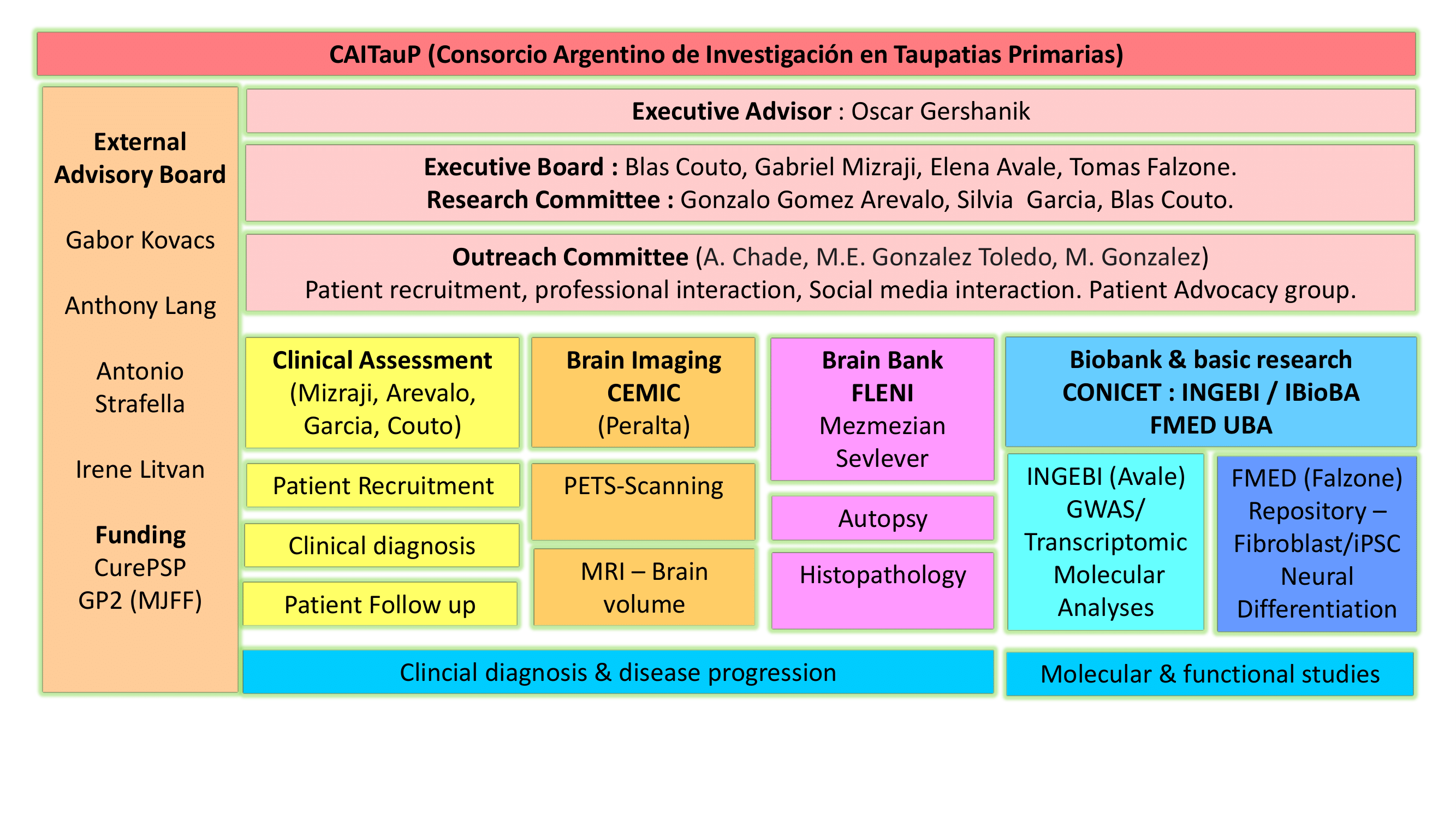
CAITauP unites neurologists and researchers from multiple institutions, creating a collaborative network that integrates diverse expertise from medicine and biology. Together, we advance research on tauopathies through complementary areas of study:
1 - Clinical Evaluation
- Patient enrollment, clinical diagnosis, and follow-up
- Site: Fundación Favaloro – Abnormal Movements Unit
- Leads: Dr. Gonzalo Gómez Arévalo (protocols & analysis), Dr. Gabriel Mizraji, Dr. Blas Couto, Dr. Silvia García (patient care)
2 - Brain Imaging
- Brain imaging analysis of enrolled patients
- Site: CEMIC
- Lead: Dr. Cecilia Peralta
3 - Brain Bank
- Autopsies and histopathological examinations
- Site: FLENI
- Leads: Dr. Mónica Mezmezian (autopsies & diagnostics), Dr. Gustavo Sevlever (Director)
4 - Basic Research & Biobank
iPSC Repository
- Fibroblast collection from patients and generation of cultured neurons
- Site: Faculty of Medicine, University of Buenos Aires
- Lead: Dr. Tomás Falzone
Molecular Analyses
- Transcriptomic and proteomic studies of postmortem brain samples
- Molecular characterization of cultured neurons
- Testing therapeutic compounds in patient-derived neurons
- Genetic anaylsis of patients
- Site: INGEBI-CONICET
- Lead: Dr. Elena Avale
To achieve its objectives and ensure the continuity of the program, CAITauP has secured funding from diverse sources. Our research proposals have been peer-reviewed and approved by globally recognized institutions that have chosen to collaborate with this ambitious project.
At the same time, the consortium acknowledges its role within the scientific community and is committed to sharing its findings and disseminating the results of ongoing studies.
Funding
(2025-2028) GP2 : Case-control study and genetic variants analysis of atypical parkinsonism patients in Argentina
- Underrepresented Populations Program
(2024-2026) GP2 - MJFF: GWAS analysis in a cohort of Argentinean patients with atypical parkinsonism
Publicaciones:
Angel, M. J., Mizraji, G. F., Gomez-Arevalo, G., Silvia, G., Gonzalez-Toledo, M. E., Elena, A., ... & Blas, C. (2025). Prospective longitudinal cohort of Argentinean patients with progressive supranuclear palsy and corticobasal syndrome: A platform for epidemiological and translational research. Clinical Parkinsonism & Related Disorders, 12, 100339.
How can I contribute with the consortium?
If you are a neurologist or a pacient, you may contact Maria Elena Avale (elena.avale@conicet.gov.ar) for more information.